We were talking about repairing a wooden trunk that we could use as a side table if it didn’t keep falling apart when it’s moved. I reckoned a dab of cola blanca around the dowels would do the trick when we put it back together again.
At which point my partner announced, “Creo que hay un sargento entre las herramientas en el invernadero.”
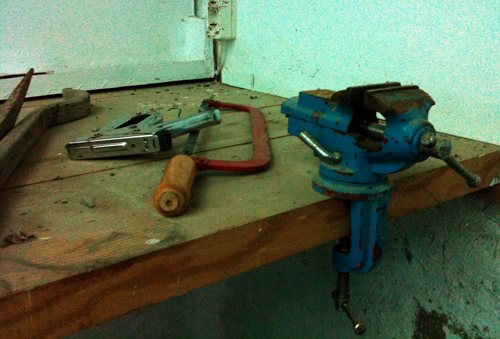
OK. We’ll gloss over the fact that we keep tools in the greenhouse – although this explains the slightly greenish tint to the photo – and focus on the “sargento”.
What was a sergeant doing with the tools, and what was his relevance to the simple repair we were about to undertake?
Checking the RAE dictionary left me none the wiser, as all the definitions are related to the millitary. I could only assume, then, that it’s a colloquial term. And where better to find colloquial terms and definitions than in wikipedia? There, under herramientas de carpintería, “sargento” is defined as:
una herramienta manual de uso común en muchas profesiones, principalmente en carpintería, que se compone de dos mordazas, regulables con un tornillo de presión.
I’d got all excited about having discovered a new mnemonic to do with sergeants and vices, but after checking with my partner I find that un sargento is actually a “clamp”, rather than a bench vice like the one shown in the photo. That would be una morsa – a walrus.
Ah well, perhaps the loss of a pun doesn’t matter: particularly as it’s just added a whole new layer of meaning to The Walrus and the Carpenter. In Carroll’s poem, I suppose the vice was gluttony, which leads me on to the gula del norte – the surimi-style elvers that are so popular in Spain at this time of year – although it was oysters not eels that feature in the poem.
Finally, just to link it back to the sergeant in the greehouse, I wonder if the walrus’s moustache would be acceptable in the military.

 don't confuse the narrator