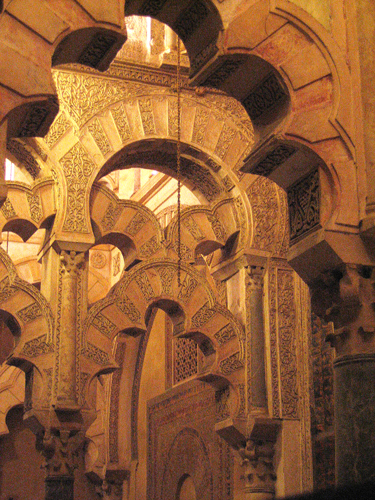
According to the guide book I’m translating, the great Mosque-Cathedral in Córdoba boasts arcos polilobulados. Isn’t that a wonderful word? (Brits of a certain age will understand that it immediately made me think of Bill and Ben.)
Unfortunately, it’s the type of word that is liable to terrify a non-native reader: all those vowels, all those syllables… it must be complicated.
And, of course, it isn’t in the diccionario de la Real Academia, which makes it even more worrying.
This happens so often when you’re reading a foreign text: a word isn’t immediately obvious, so panic sets in.
Often, as is the case here, if you can hold back the panic, things aren’t half as difficult as they appear.
A moment’s thought should tell us that the Spanish prefix poli is the equivalent of ‘poly’ in English. So in fact the arches are just multi-lobulados. At this point we could turn to the dictionary and look for lobulado, or we could do a little more thinking.
The ending ‘ado’ means it’s an adjective. Often this would indicate that it’s a past participle acting as adjective (i.e. it was formed from a verb, in the way that hablado – ‘spoken’ – comes from hablar – ‘to speak’.) That actually isn’t the case here, but if we mistakenly posit the (non-existent) verb lobular it gives us a recognisable English word: ‘lobular’ – the adjective associated with ‘lobe’. So polilobulado is simply “multi-lobed”.
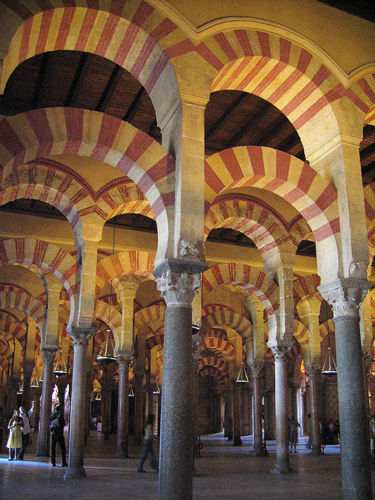
To be honest, I’m not a hundred per cent sure if the arches being described are like the ones in the first photo, or more like those on the left, here, which is probably the image most commonly associated with the Mosque.
But I certainly understand the word well enough to translate it.

 don't confuse the narrator