of shoe-cleaning and elephants

elephants' ears leaves

I’ve been back in the DCTN archives discussing narrators – first person and third person – and what’s ‘real’ in my poetry, and have just written that the inspiration for a poem is almost certainly something in my life, but it isn’t necessarily something real that actually happened to me.

The trigger may be a personal experience, or it may be something I read or overhear, or something from today that I connect through to something half remembered from the past etc. I then take that kernel of an idea and extrapolate it and link it with other images and ideas to create a poem. The same trigger can inspire different poems in different styles or forms and with different protagonists, and the information that fleshes it out may come from personal experience, research or imagination.
Continue reading “of shoe-cleaning and elephants”

more school memories

Yesterday I said that one of my school teachers seemed to believe that pleasure taken in the sound and general impression of poetry was more important than the ability to understand and explain the details of each word and image. Forty years later, I am very glad that was her attitude.

poetry books on a shelf

Another memory from that time at school was the context – or, more accurately, lack of context – for the poetry we were studying.
Continue reading “more school memories”

writers, narrators, realism and reality

I’m a firm believer that poetry isn’t all about sunny situations and pleasant people, which is one reason why it’s particularly important to separate what’s said in the poem from the person who wrote it.

It is, however, often difficult to show a narrator’s inadequacies without the writer coming across as inadequate as a poet or as a person: if you create a convincingly weak character in your writing, it isn’t always clear that the weakness is intentional.
Continue reading “writers, narrators, realism and reality”

better late than never

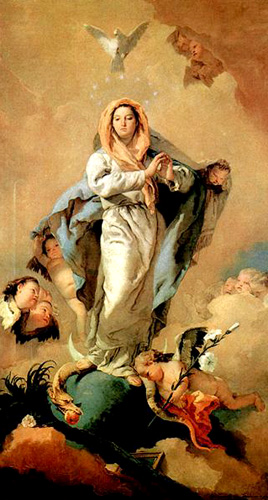
This should, of course, have been posted a couple of days ago for the fiesta de la inmaculada concepción on the 8th, but I’d completely forgotten its existence. It was written as an example of ekphrasis – in this case, a poem inspired by a painting – and I think for once it’s absolutely clear that I am not the narrator.

Tiepolo: inmaculada concepción
'La Inmaculada Concepción': Tiépolo
Inmaculada

Es injusto, ¿sabes? They’ve hung me here,
expect me to balance on this blue-green planet,
not to slip and do myself a permanent
impaled on that luna creciente, despite the worm
at my feet and this beastly little cherub
pulling at my cloak while his colegas try
and sneak a peek up under my robe;
I’m pretty sure that even that one
over on your right who’s looking
rather more demure is actually
checking in the mirror, just in case
he gets a better view.
As for the clothes, ¡qué asco
de ropa me han dado!
Couldn’t they afford
a bit of lapis lazuli? They call me
“Queen of Heaven” and yet they dress me
in the dowdiest of drab without a flounce
or furbelow. It’s no good telling me
my sandals have peep toes – sin plataformas,
ni tacones
they’re not exactly what you’d call
“letizios”, now, are they? And what about
that blessed bird? Everybody thinks
that it’s a crown of stars I’m wearing, whereas,
in fact, it’s all the good-luck guano
Paloma, there, has found it in her sacred corazón
– or elsewhere – to contribute to this travesty
of taste. No es justo, like I said;
it isn’t fair: here I am, in Spain, hung
on the Prado wall, while out there
in the street, they’re living la movida Madrileña.
Can’t anybody see I’d really rather be
a flamenco dancer?

facts and fictions

A few more thoughts on the subject of how accurate we should be when we write poetry:

A few days ago, I had cause to look up Keats’ On First Looking into Chapman’s Homer, and I read the Wikipedia page. (The poem appears there, too.)

Despite what it says in the poem, it wasn’t “stout Cortez” who stood “Silent upon a peak in Darien”, but Nuñez de Balboa. But although the error was identified, apparently

“Keats chose to leave it in, presumably because historical accuracy would have necessitated an unwanted extra syllable in the line.”

Continue reading “facts and fictions”