accuracy in advertising

I understand that there are people who have little grasp of the grammar, syntax and spelling of their own language, but should they really be allowed to work in jobs that require them to write for the public?

Texts published on web pages are often faulty – many are written by badly paid hack writers with a deadline to meet – but it’s fairly simple to go back and correct them.

Slogans and texts for major advertising campaigns, on the other hand, are worked on by teams of professionals and they pass through the hands of many people before being approved. And yet we get things like this:

Advertising slogan: "It's time oil companies get behind the development of renewable energy"

Continue reading “accuracy in advertising”
“it killed the ancient romans…”

Despite being as ready as any of my classmates to chant the rhyme –

Latin is a language as dead as dead can be;
It killed the ancient Romans, and now it’s killing me.

– Latin was actually my favourite school subject and I have long believed it was the most useful subject I studied.
Continue reading ““it killed the ancient romans…””

penny for them

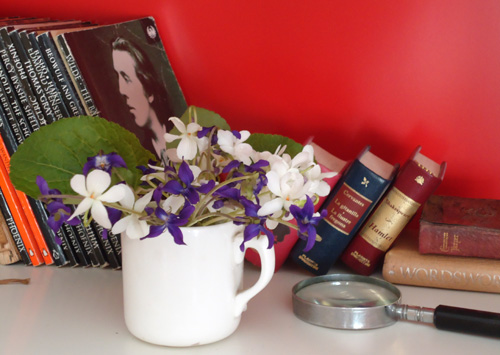
After a fairly miserable weekend weather-wise, Monday dawned bright and sunny and positively spring-like. So I took the opportunity to gather some violets for my desk.

violets

(In the photo they are on the book shelf simply because it’s tidier than the desk.)
Continue reading “penny for them”

attached to the past

Assorted types of paper fastener

While looking for a picture of a quill pen the other day, I came across several pictures I took to accompany an article on stationery written many years ago.This one particularly appealed, and though I’m not sure I’ve got anything very witty or insightful to write on the subject, I thought I’d include it here.

I suppose I could mention the confusion between the words ‘stationery’ and ‘stationary’.
Continue reading “attached to the past”

writers, narrators, realism and reality

I’m a firm believer that poetry isn’t all about sunny situations and pleasant people, which is one reason why it’s particularly important to separate what’s said in the poem from the person who wrote it.

It is, however, often difficult to show a narrator’s inadequacies without the writer coming across as inadequate as a poet or as a person: if you create a convincingly weak character in your writing, it isn’t always clear that the weakness is intentional.
Continue reading “writers, narrators, realism and reality”