contradictionary

In a story on 20 Minutos, the on-line version of one of Spain’s free newspapers, The Secretary of the Real Academia Española, Darío Villanueva is quoted as having said:

“El Diccionario no puede ser políticamente correcto porque la lengua sirve para amar, pero también para insultar. No podemos suprimir las palabras que usamos cuando nos enfadamos o cuando somos injustos, arbitrarios o canallas.” *

I find this odd, as I thought the whole point of the RAE was prescription not description.
Continue reading “contradictionary”

censorship, censure and nonsense

An email with the subject line ‘escultura censurada’ caught my attention a couple of days ago and had me wondering whether the sculpture in question had been censured or censored.

fountain - el baño de Ataecina

Reading on, I think both verbs were appropriate.
Continue reading “censorship, censure and nonsense”

‘a tower to the sun’

castle and palm trees

castillos en el aire – ilusiones lisonjeras con poco o ningún fundamento

I wonder how many Spaniards realise that as well as building castles in the air, English speakers also build castles in Spain.

Perhaps more to the point, I wonder why we do.

Brewer tells me that

[…] air-castles were called by the French Châteaux d’Espagne because Spain has no châteaux.

I wonder who told him that yarn.
Continue reading “‘a tower to the sun’”

benchmark

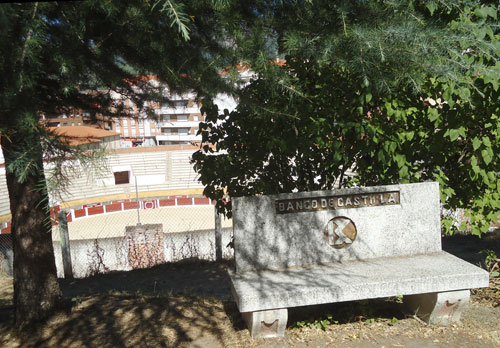
stone bench

I am amused by this stone bench up beyond the bull ring in Arenas de San Pedro, Castilla y León, central Spain.

Well, not so much amused by the bench, but by the engraving on it, which seems to be extraordinarily apt:

Banco de Castilla engraving on stone bench

Banco de Castilla no longer exists as an independent bank, but I am glad the benches it sponsored have not been removed. They are indeed bancos de Castilla – Castilian benches.

polish/spanish/english: a few thoughts on poetry & other writing

The revista literaria El Malpensante has an interesting article based on the column written in a Polish newspaper for 30 years by the Nobel prize winner Wislawa Szymborska.

In Cómo escribir and cómo no escribir poesía they have selected a few of the replies Szymborska made to readers who aspired to write poetry. Most of the article is interesting, but I have selected just two snippets.

The first, chosen because it ties in with my interest in translation:

Para H. O., de Poznan, un posible traductor
El traductor no está obligado a serle fiel al texto únicamente. Debe dejar ver la belleza de la poesía conservando su forma y reteniendo, en la medida de lo posible, el estilo y el espíritu de la época.

Continue reading “polish/spanish/english: a few thoughts on poetry & other writing”