wild boars and motorbikes

During a break in the rain this afternoon, I went for a brief walk. The whole thing only took me about 40 minutes, and I met and spoke to three guys. The first, walking a small dog along the road down by the river, simply wished me good afternoon. Then I turned off the road onto a trail up between the olive groves and towards the pine woods.

There I met a neighbour whose first reaction was, “¿No tienes miedo de caminar por aquí?” I said no, I wasn’t afraid, and he hastened to assure me there were lots of jabalíes in the area; he definitely seemed concerned when I didn’t pale at the thought of bumping in to a wild boar in the middle of the afternoon half a mile from my own back yard.
Continue reading “wild boars and motorbikes”

carry on shopping

Living in Spain, there are times when I feel as if I am looking at life through linguistic bi-focals: one lens is my mother tongue, English, the other is the local language, Spanish (Castellano).

Alimentación carrion - village shop
So, when I see signs like the one in the picture (taken in a small town in the province of Cáceres), I understand perfectly that it’s a village grocery store – indicated by “alimentación” – but I also notice that it appears to be selling “carrion”. Such vignettes add a touch of the surreal to life.

found wanting

Poster (text - Yes, we want)
And apparently, we need (to), too
Over the last couple of weeks, I’ve been reviewing the translation of a novel with the author. Time and again, we’ve come up against what she sees as limitations in the English language.

One of the biggest problem has been with words that are gender non-specific. With a word like “saint”, “patient” or “teacher” it’s unclear whether it refers to male or female, whereas in Spanish you have the pairs santa/santo, profesor/profesora, and with words like paciente it’s simply a question of changing the gender of the article: el paciente/la paciente.
Continue reading “found wanting”

concrete imagery

No, I’m afraid it’s not a post about problems with abstractions in poetry, although that’s a subject dear to my heart. This is literally about images and concrete. Or, to be more precise, images and cement.

empty cement sack
Just the facts
I used to think cement was a fairly uninspiring grey powder that came in tough brown paper sacks with nothing of any interest written on them.

I imagined that the packaging was designed to appeal to no-nonsense men who deal in practical information like quality codes or weights and measures. A bit like the empty sack in the photo.

But then I caught sight of un saco de cemento with the slogan:

Tu salud está en tus manos.
Este cemento no provoca dermatitis alérgica.

and realised the subject was rather more complex.

How would you illustrate the packaging of a hypoallergenic cement?
Continue reading “concrete imagery”

using language

I hadn’t realised that the library in Navarredonda was following a long and honourable Spanish tradition with their sign listing their rules and regulations for behaviour.

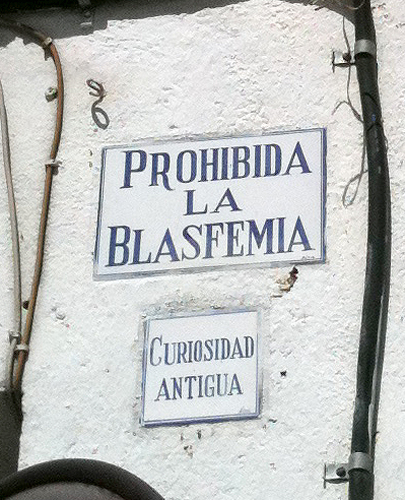
No blaspheming
Still, the tile in the photograph was spotted embedded in the wall outside a bar in Pedro Bernardo and does seem to be a genuine antique.

Presumably, though, the residents don’t want visitors to think that they are quite so stuck in the past as a ban on blasphemy and the image of a pony parked in the bull ring might lead you to believe. At least, I assume that’s why they felt the need to add the small explanatory tile that reads, “curiosidad antigua”.
Continue reading “using language”