quibbles & niggles

Having picked up Pride and Prejudice to look up Bingley’s comments on accomplishments the other day, I decided to re-read the whole book.

Along with Kipling’s Kim, it’s one of my ‘comfort books’; this time, however, I wasn’t reading it while ill in bed, so perhaps I was more critical. Certainly it struck me that it would be hard to cite Austen as a role model for good writing.
Continue reading “quibbles & niggles”
a ‘fuller’ understanding

I have finally had time to read the copy of the TLS that I bought over a month ago. There’s a piece entitled The brick-wall moment – What is poetry about? And other puzzles, which appears in a section labelled ‘Commentary’.

I’m not sure I’d have read it with quite the same attitude if I’d realised it was an edited extract from a book, but it was a lot more interesting than the formal review in the Independent of Who is Ozymandias? And other puzzles in poetry by John Fuller.
Continue reading “a ‘fuller’ understanding”

motivation II

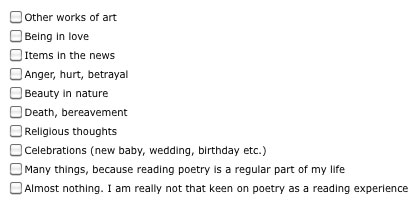
The survey I mentioned yesterday also had a question that asked “What is most likely to motivate you to READ a poem?” It gave the following list of possible reasons, from which you were allowed to choose up to three:

reasons for reading a poem

Continue reading “motivation II”

of shoe-cleaning and elephants

elephants' ears leaves

I’ve been back in the DCTN archives discussing narrators – first person and third person – and what’s ‘real’ in my poetry, and have just written that the inspiration for a poem is almost certainly something in my life, but it isn’t necessarily something real that actually happened to me.

The trigger may be a personal experience, or it may be something I read or overhear, or something from today that I connect through to something half remembered from the past etc. I then take that kernel of an idea and extrapolate it and link it with other images and ideas to create a poem. The same trigger can inspire different poems in different styles or forms and with different protagonists, and the information that fleshes it out may come from personal experience, research or imagination.
Continue reading “of shoe-cleaning and elephants”

more school memories

Yesterday I said that one of my school teachers seemed to believe that pleasure taken in the sound and general impression of poetry was more important than the ability to understand and explain the details of each word and image. Forty years later, I am very glad that was her attitude.

poetry books on a shelf

Another memory from that time at school was the context – or, more accurately, lack of context – for the poetry we were studying.
Continue reading “more school memories”