Last Bank Holiday weekend, I posted Spring lamb with floral trimmings, which included a poem I’ve had in my files for a long time under the title Easter Edition. I’ve always thought it was a weak title but hadn’t come up with anything better. Now I’m wondering whether using the post title, or something similar, such as Lamb with apple-blossom garnish, would be a good idea, or whether it would just be gimmicky.

Continue reading “entitled”
Tag: writing poetry
time and distance

I have been sorting out papers and have come across a few poems which seem to have slipped through the cracks when copying from one computer to another over the years: I don’t have copies on the current laptop, and I don’t remember seeing printed copies recently.
I haven’t exactly forgotten them, though, as the title or first line is enough to trigger almost complete recall of the words. This is why I find editing and revision so difficult: by the time I commit the words to writing, they have become fixed in my mind.
When I came across Cousin Grace it was like seeing a familiar face – albeit one I feel could do with a make-over:
Continue reading “time and distance”
drafts and re-drafts

Form, metre, rhyme etc. are superficial elements of a poem. What gets translated is something more essential.
Recently, I’ve been thinking a lot about poetry translation, and I’m trying to work out what that “more essential” something is.
It’s clear – to me at least – that the complexity of poetry, its inherent weaving of different linguistic techniques, makes it impossible to translate everything: the only way to get an exactly equivalent poem would be to repeat the original. (At which point, it is probably relevant to mention the Borges short story Pierre Menard, autor del Quijote.)
Continue reading “drafts and re-drafts”
some squirrels and a Wren
The squirrels in the previous post were photographed in St Paul’s churchyard, London. Like the ones I remember from the parks of my childhood, they were very friendly and keen to be fed by the tourists.
Nearer to home there are wild squirrels who visit and use the flower pots on the patio as storage jars for their winter supplies; they are not at all tame – which is why I couldn’t get closer for the next picture – but they do seem to have learned their kerb drill:
Continue reading “some squirrels and a Wren”
serial poetry
Currently, my mind seems as empty of poetry as the teasel head is of flowers. But I am used to the emptiness, and the idea of “writer’s block” is not something that particularly bothers me.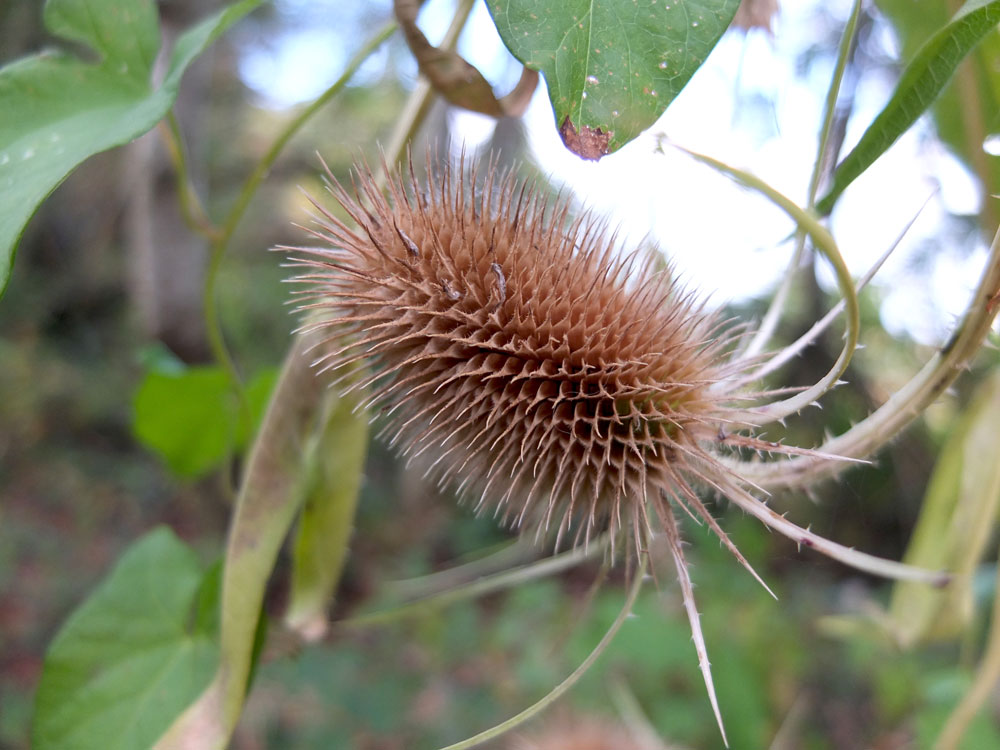
Recently, a friend said she would sometimes take “as long as eleven hours” to write a poem. She is a skilled writer, with many small prizes and multiple publications to her credit, so this clearly works for her. But her writing seems to be more methodical than mine, and I gather that she works on each piece diligently until it is complete before starting the next one.
This is not at all the way I work.
Continue reading “serial poetry”
 don't confuse the narrator