little red books

I’ve said before that this is not a political blog, but today I was saddened to hear of the death of Tony Benn, one of the great politicians of my youth. Ed Miliband has apparently paid homage, saying:

[Tony Benn] will be remembered as a champion of the powerless, a great parliamentarian and a conviction politician.

I’m not sure what a conviction politician is, but I suspect the world might be a better place if a few more politicians were convicted.

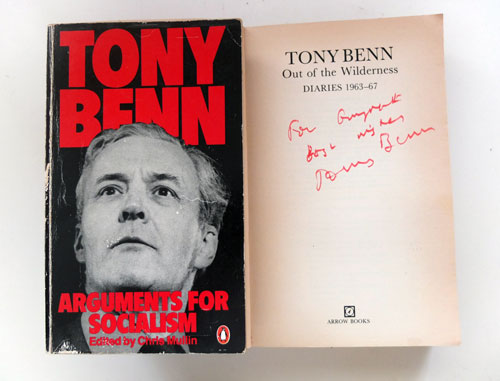
In 1990, I was given four of Benn’s Diaries, all autographed in red pen.
Tony Benn books
I admit I haven’t read them, although the earlier – and shorter – Arguments for Socialism does look well-thumbed. I have, however, been happy to know they are there on the shelf.

I’ve just checked to see that the damp hasn’t got to them (it hasn’t), and find them suitably placed alongside Prince Peter Kropotkin, Engels and E.P. Thompson. (All of them little read books.)

If I believed in such things, I would probably be hoping that Mr Benn might find himself in such company tonight.

pedantry & poetry

"James Anderson becomes only the fourth England player to take 300 Test wickets during the first Test against New Zealand."

Cricket Tests are renowned for how long they last, but the BBC news to the right seems to imply they might go on for weeks: if Anderson was the fourth to take 300 wickets in the first Test, then three others had done so before him.

Just how long does it take for 1200+ wickets to be taken?

Elsewhere on the BBC last week I read their College of Journalism blog post: We all love lists, but are they all journalism?
Continue reading “pedantry & poetry”

of death and celandines

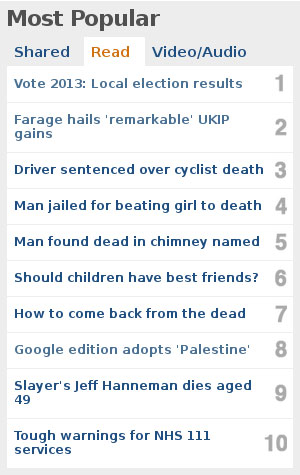
The past week has been less than positive in many ways and, judging from the screenshot below, I’m not the only person to feel that way.

BBC headlines May 3 2013 -  it's all about death
Of the headlines for the top ten most popular stories, five contain a variant of the word ‘death’.

Whether the local election results (stories 1 and 2) have anything to do with the BBC readers’ apparent morbid obsession, I don’t know.

Perhaps they’ve been unable to get through to the new NHS 111 service (story 10) and while waiting for their urgent but non-life-threatening health problems to be attended to they have felt the need to console themselves with reading how things could be worse.

The screenshot is from a couple of days ago (“thanks!” to the reader who sent it to me) and it suited this week’s aura of negativity.

I was beginning to feel things were never going to improve.
Continue reading “of death and celandines”

pan y paz

Bread and peace. Those are the basics (is peace a basic?) that the strikers are demanding.

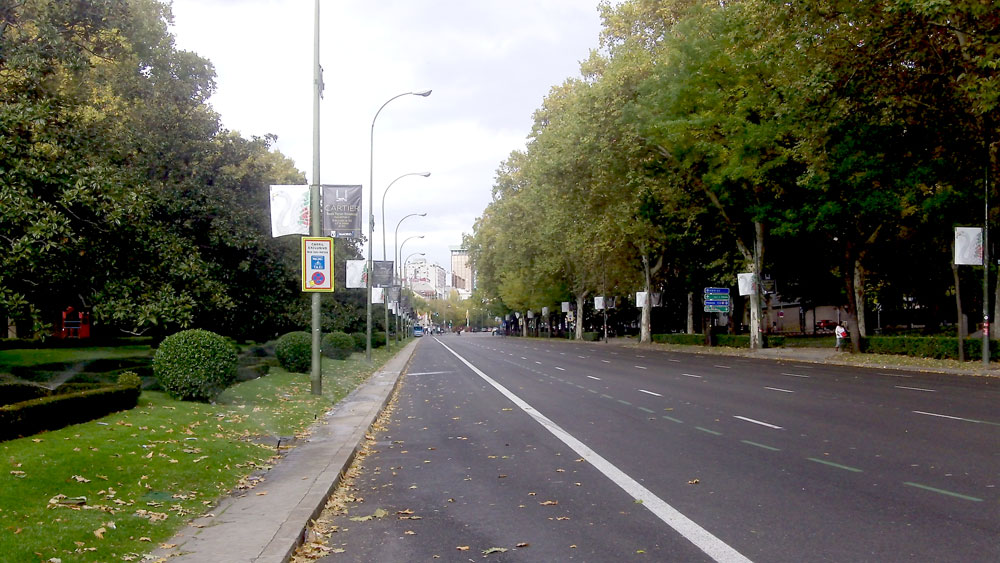
I’ve just watched the TV news and there are huge crowds demonstrating in Plaza Colón and around the fuente de Neptuno. But this photo was taken just north of Neptune about five hours ago, when the mass of manifestación was elsewhere. The tall building just visible in the far distance (click the image for a closer view) is up by Colón.

Paseo del Prado, Madrid
For a few moments then, until the traffic lights behind me changed and I had to leap onto the pavement, it looked like we actually did have peace.

questions arising

I see from the BBC website that “CIA director David Petraeus has resigned from his post, admitting he had an extra-marital affair.”

“Unnamed officials” say the affair was with his biographer, who is described in the article as having spent months “embedded alongside the then-general in Afghanistan while researching her 2011 book, All In: The Education of General David Petraeus.”

Leaving aside that use of the verb “embed”, I think the story raises a few questions:

Did she include details of the affair in the biography? If not, can we trust the accuracy of anything else in the book?

Between a biographer and their subject, is there not a “power-relationship”? After all, she could make him look better or worse depending on how she expressed the information? Was he coerced?

She, too, was married. Is she going to resign as a biographer? (It seems to me that the affair impinges more directly on her work than on his.)