A photo just sent to me from Barcelona: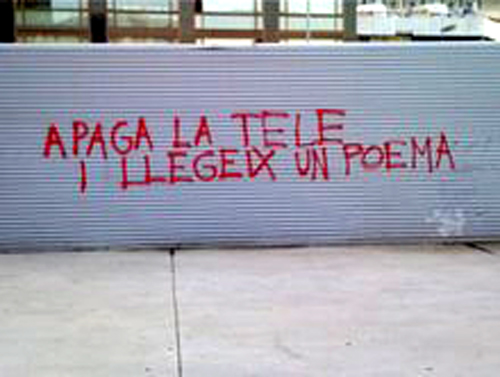
In case you can’t guess, it says: “Switch off the telly and read a poem.” Which sounds like a good idea to me.
A photo just sent to me from Barcelona:
In case you can’t guess, it says: “Switch off the telly and read a poem.” Which sounds like a good idea to me.
I should probably start this post by saying that I know my grammar and punctuation aren’t perfect. However, I’m not usually writing about politically and emotionally delicate matters; and I’m not writing on an international news site which is read by millions worldwide.
It bothers me when I see phrases like this on the BBC website:
“I absolutely condemn sexual tourism [and] I condemn paedophilia in which I have never in any way participated, and all the people who accuse me of that type of thing should be ashamed,” Mr Mitterrand said.
A friend happened to comment that the latest edition of the Radio Times had meerkats on the front cover.
This got me wondering why meerkats hadn’t been “invented” when I was in school – they’re like an internet meme that sprang fully-formed in the public consciousness just a few years ago – and I did a quick bit of on-line research.
Continue reading “ferreting around on the web”
According to the BBC news Magazine, the phrase “hey-ho” is set to make a comeback: it is included in the new edition of the Collins English Dictionary where it is defined as “an exclamation of weariness, disappointment, surprise, or happiness.”
Duncan Black, an editor for the dictionary, is quoted as saying “It’s the verbal equivalent of a shrug; you say ‘hey-ho’ or ‘that’s the way it goes’ or ‘c’est la vie.'” (He doesn’t mention the Spanish ‘es lo que hay’ – ‘that’s what there is’ – which is one of my personal favourites.)
Continue reading “ho hum”
…tick if you don’t.
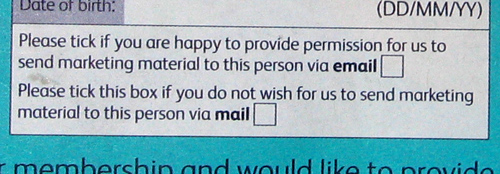
My mother has asked me to fill in a form for her. With options like the above, I’m not at all surprised she’s confused.
Much as I’d like to suggest the organisation investigate the Plain English Campaign, I fear that the real reason for the bad phrasing is to confuse people into unintentionally giving permission for their friends and family to be included on junk mail lists.
 don't confuse the narrator