all the rage

I haven’t been following the X-factor/Rage Against the Machine story, but it’s one of those things that filter through even if you aren’t the least bit interested in it, and the headlines this morning make it unmissable.

Even so, the only real interest I have in the story is that it’s triggered a memory of being asked by a Swedish friend’s son, back in the early Nineties, what Rage Against the Machine meant.
Continue reading “all the rage”

a different creed

I used to work in Millbank Tower in London and of all the city’s many galleries and museums, the one I am most familiar with is the Tate – Tate Britain as it is now. When in London, I usually try and find time to visit.

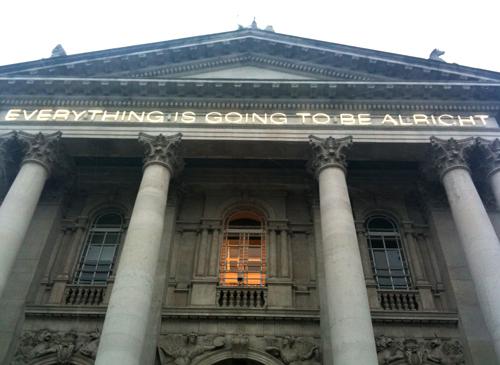
Apparently next year they are going to start to allow photography, but at the moment the only works you can take pictures of are a few sculptures at the entrance and the works displayed outside. Which includes the 1999 work by Martin Creed, currently displayed on the building façade above the Millbank entrance:

"Everything is going to be alright"
Continue reading “a different creed”

it rings a bell

This headline has caught my attention:

...with  bells on
...with bells on

Whether it was in any way connected with Global Handwashing Day, which fell a few days ago, I don’t know.

It was of course the use of the verb “ring” that caught my eye. I’m pretty sure that even in American English that should be “wring”.

Actually, there was far more to set me thinking in the article, which started off:
Continue reading “it rings a bell”

parenthetical pedantry

The more I read on-line, the more I think the mathematicians have it right. The meaning of 4+3*6 is perfectly well defined. You have to do the multiplication first.

If you want to force the addition to be be done first, you just slip in some parentheses: (4+3)*6.

Sadly, text isn’t like that. And with the internet encouraging writing by all and sundry, and forcing hurried writing by those who should know better, it’s easy to produce potentially ambiguous statements like this, from a piece about the need to encourage social inclusion by reading, on the London Book Fair site:

Not only are those who read less likely to be divorced, but they are less likely to smoke and be unemployed

My original reading of the first phrase parsed “those who read less” as a unit, and the phrase apparently claimed members of this group were “likely to be divorced”.
Continue reading “parenthetical pedantry”
pedantry

I should probably start this post by saying that I know my grammar and punctuation aren’t perfect. However, I’m not usually writing about politically and emotionally delicate matters; and I’m not writing on an international news site which is read by millions worldwide.

It bothers me when I see phrases like this on the BBC website:

“I absolutely condemn sexual tourism [and] I condemn paedophilia in which I have never in any way participated, and all the people who accuse me of that type of thing should be ashamed,” Mr Mitterrand said.

Continue reading “pedantry”