I’ve been keeping an eye on the daffs outside my window for the last month and wondering if they’d make it out in time.
In the end, despite showing colour for a week now, they haven’t. Perhaps later on today, if the sun keeps shining, they will unfurl their yellow flounces in celebration of St David’s day.
Mind you, they aren’t real daffs, anyway, as they are multi-petalled, double flowers, not the clear bright-trumpeted kind that line the road down to South Wales.
I'm lichen it“The times they are a-changing.” Or, at least, the weather is. And in Spanish, of course, tiempo is the word for both time and weather. (More about that in the ‘having a good time’ post.)
Yesterday, I sat outside sun-bathing and watched the very first swallows of the season sitting on the phone wires apparently tidying themselves up after their long journey.
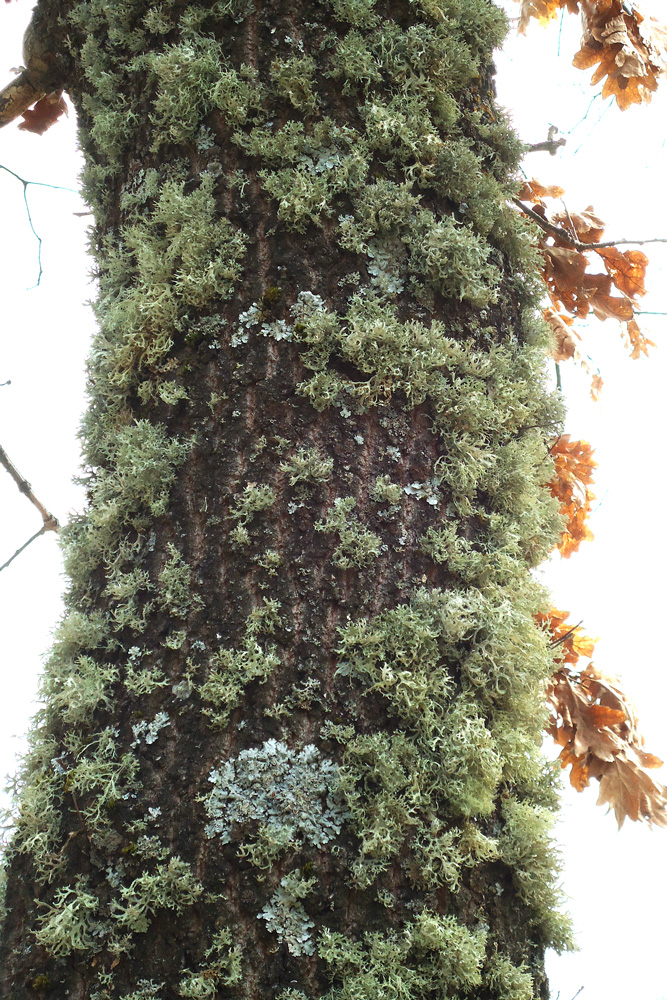
Today the wind is howling, and the sight of the the billowing tree tops through the window is enough to make any one feel sea-sick. Perhaps the oak tree in the photo will be pleased to be wrapped up warm in its furry green coat.
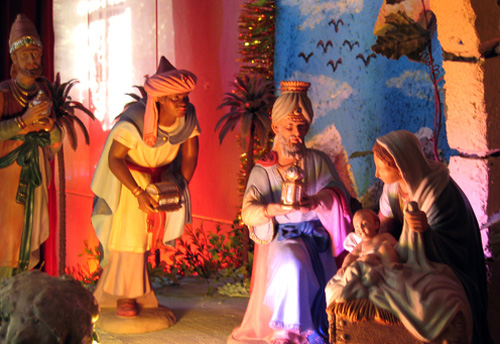
Today is January 6th: el día de Reyes, the day when Spanish children finally get their Christmas presents. (Although we were told that Santa took gifts to children all round the world, he doesn’t visit many houses in Spain as he leaves it to the Magi to deliver the parcels – or coal for those who’ve been naughty – on Twelfth Night.) It would make more sense to me if the kids got their toys at the start of the school holidays so they had something to keep them occupied, but I guess los niños españoles spend their time watching TV and adding more and more items to their wish lists as they see the different juguetes advertised during the half-hour commercial breaks. Continue reading “kings, sages and magicians”
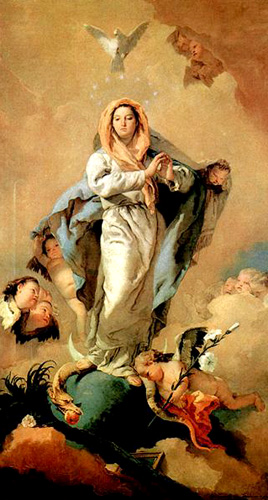
This should, of course, have been posted a couple of days ago for the fiesta de la inmaculada concepción on the 8th, but I’d completely forgotten its existence. It was written as an example of ekphrasis – in this case, a poem inspired by a painting – and I think for once it’s absolutely clear that I am not the narrator.'La Inmaculada Concepción': Tiépolo Inmaculada
Es injusto, ¿sabes? They’ve hung me here,
expect me to balance on this blue-green planet,
not to slip and do myself a permanent
impaled on that luna creciente, despite the worm
at my feet and this beastly little cherub
pulling at my cloak while his colegas try
and sneak a peek up under my robe;
I’m pretty sure that even that one
over on your right who’s looking
rather more demure is actually
checking in the mirror, just in case
he gets a better view.
As for the clothes, ¡qué asco
de ropa me han dado! Couldn’t they afford
a bit of lapis lazuli? They call me
“Queen of Heaven” and yet they dress me
in the dowdiest of drab without a flounce
or furbelow. It’s no good telling me
my sandals have peep toes – sin plataformas,
ni tacones they’re not exactly what you’d call “letizios”, now, are they? And what about
that blessed bird? Everybody thinks
that it’s a crown of stars I’m wearing, whereas,
in fact, it’s all the good-luck guano
Paloma, there, has found it in her sacred corazón
– or elsewhere – to contribute to this travesty
of taste. No es justo, like I said;
it isn’t fair: here I am, in Spain, hung
on the Prado wall, while out there
in the street, they’re living la movida Madrileña.
Can’t anybody see I’d really rather be
a flamenco dancer?
When I went to university, it was still obligatory for all students to have basic maths and English qualifications, whatever they were going to study. Even today, I’d be surprised if you could become “a scientist” (whatever that might mean) without knowing some simple arithmetic.
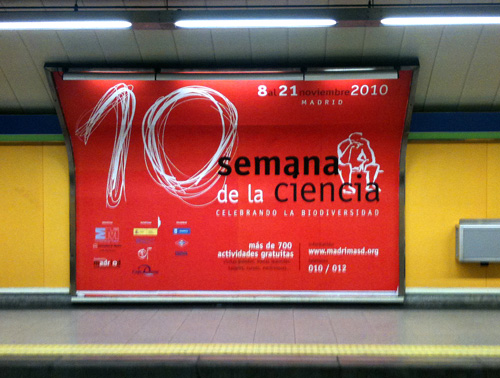
So how come the Madrid Science Week is scheduled to last from 8th to 21st of November? My calculations make that 13 nights/14 days, which is a lot longer than a week.
(Note that isnt really a ‘fortnight’, though, as that would be 14 nights, equivalent to the Spanish quincena which is 15 days.)

 don't confuse the narrator