
As I’ve said before, not only do Google adapt their logo according to the date, but they do so according to location, too. I find it strange, though, that June 21st should warrant a special logo only on the google.es page – celebrating el inicio del verano – and not on the .com or .co.uk versions. After all, surely summer starts on the same day?
Continue reading “summery”
Sound reasoning
A couple of weeks ago, on the Tantamount Words blog, I wrote about the USA Spelling Bee and commented about how a knowledge of the etymology of a word can help with spelling, particularly in a language like English where many different languages have contributed to the vocabulary.
Often, knowing how a word is pronounced is little help when it comes to writing it, but I personally don’t favour spelling reform as the written form can give us all sorts of clues about word families and relationships.
Continue reading “Sound reasoning”
being superstitious is lucky
Stevie Wonder may have been wrong when he sang “When you believe in things that you don’t understand, then you suffer.” According to an article on PhysOrg.com, German researchers have demonstrated that being superstitious can actually improve performance: if you have your lucky charm with you, you feel more confident and perform better. There again, it probably works the other way, too, and losing your amulet will make you perform worse.
Of course superstitions vary between cultures. I imagine that an English speaker who takes a test on Friday 13th will underperform, whereas a Spaniard would do worse if it was martes 13.
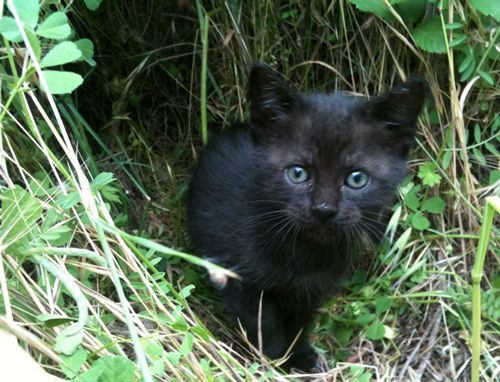
Which gives me an excuse for posting this photo.
Where English readers will see it as a good omen, Spaniards will think it augurs ill.
Either way, it seems a big responsibility for such a small cat.
duties and impositions

As shown in the photo, there’s a poster taped to the church door in the village.
When I saw it, I thought it must be particularly important or they would have simply put it on the notice board along with the other general announcements.
So I went closer to have a look.
And this is what I found:
Continue reading “duties and impositions”
him-her; big-small
“Las formas femeninas suelen ser más grandes.”
Well, that may not be the exact phrase my colleague used, but it was along those lines, and it wasn’t meant to insult women in anyway. We were discussing a translation for the Mexican word cenote and he was trying to explain what it meant. Not a pozo (a well), but a poza. But what was a poza? According to the RAE, it’s a:
Charca o concavidad en que hay agua detenida.
Note that the definition uses the word charca, not charco. Again, two similar forms; so what’s the difference?
Continue reading “him-her; big-small”
 don't confuse the narrator