logic test

This morning, I wanted to make a pun on the idea of a poet as a “maker” and a poem as “a made thing”; before I did so, though, I went to Google to check that I had the etymology right. What I found reminded me of those IQ test questions where you fill in the next word in a set or in a sequence.

Here the sequence starts “poet, poem, poetry,” but the final word is not the one I would have expected:
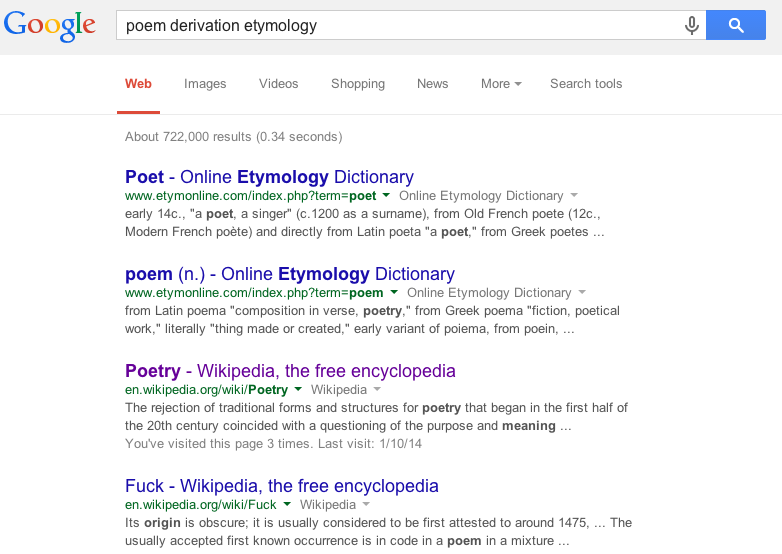
derivation of word "poem". Google results

for the birds

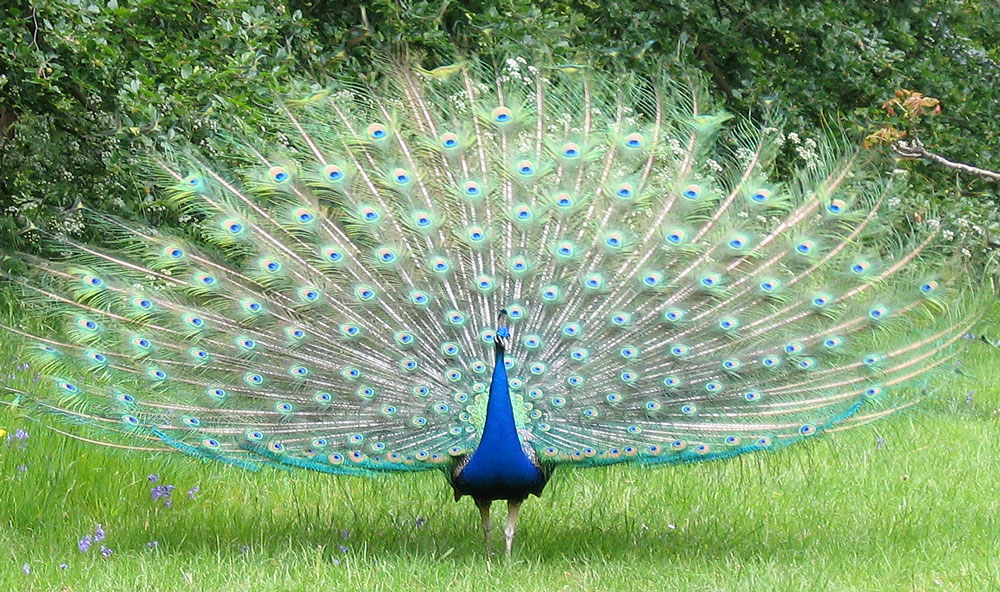
peacock with open tail

Visiting the Google page this morning, I discovered it was the anniverary of the birth of John James Audubon. Why Google had chosen to commemorate the 226th anniversary, I don’t know, but they had one of their doodles depicting a number of the birds drawn by Audubon.

(Incidentally, that link to the Google doodles page is worth a click – it appears to lead to an archive of the different logos they’ve used in all the different language and geographic versions of the Google page.)
Continue reading “for the birds”

summery

Google Spain logo 21st June 2010

As I’ve said before, not only do Google adapt their logo according to the date, but they do so according to location, too. I find it strange, though, that June 21st should warrant a special logo only on the google.es page – celebrating el inicio del verano – and not on the .com or .co.uk versions. After all, surely summer starts on the same day?
Continue reading “summery”

spanish dates

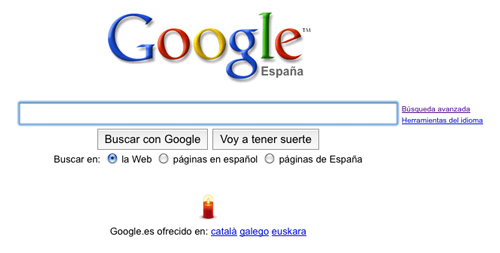
I enjoy the changed logos that Google offers to commemorate different occasions. They’re usually pretty much the same for the .com and .co.uk versions, but I notice that they don’t always appear if I’m using the Spanish version of the search (google.es).

This morning, however, I find a symbol on the .es version that is not on the English language pages:

google.es 11-m

The little red icon is so small that it’s hardly identifiable, but zooming in, it clarifies into a votive candle, and the mouse-over text reads “En recuerdo a las víctimas del 11M“.
Continue reading “spanish dates”

mornington crescent

I get the impression that Google searches work in much the same way as the Mornington Crescent game: there you are, following links, jumping all over the place and never quite sure where you’ll end up next, and then, suddenly, you find you’ve landed up where you intended.

Well, ok, with Google you’re as likely to end up somewhere quite unintended but equally interesting, so perhaps the analogy breaks down a bit.
Continue reading “mornington crescent”