accuracy in advertising

I understand that there are people who have little grasp of the grammar, syntax and spelling of their own language, but should they really be allowed to work in jobs that require them to write for the public?

Texts published on web pages are often faulty – many are written by badly paid hack writers with a deadline to meet – but it’s fairly simple to go back and correct them.

Slogans and texts for major advertising campaigns, on the other hand, are worked on by teams of professionals and they pass through the hands of many people before being approved. And yet we get things like this:

Advertising slogan: "It's time oil companies get behind the development of renewable energy"

Continue reading “accuracy in advertising”

hoy por ti

chestnuts

The first time I heard the phrase Hoy por ti; mañana por mí I was amazed at the no-nonsense approach to helping others that it seemed to encapsulate.

The closest we seem to come to it in English is “You scratch my back and I’ll scratch yours”, though I don’t think that’s quite the same, as the English idiom implies a real one-to-one reciprocity.
Continue reading “hoy por ti”

of gender and generalities

There’s a general strike planned in Spain for this coming Wednesday and this advert appears in El Público today:

  IU general strike advert

The call to action comes from the Izquierda Unida, the main left wing party in Spain (as opposed to the PSOE – the Spanish Socialist Workers’ Party – currently in power and not half as left wing as the name might lead you to expect).

Whatever my sympathies might be for the left, and for those who intend to strike, I object to the phrase nosotras y nosotros.
Continue reading “of gender and generalities”

out of its element

Earth shifter

I came across this monstrosity sitting in the local river this morning, and the word bulldozer wandered through my mind looking for something to connect with.

It reminded me of a transformer; a shape-shifting earth-shifter. I’m not sure what it was doing there other than looking slightly uncomfortable and as if someone had mistaken the nearly dry river bed for a parking space.
Continue reading “out of its element”

sign language

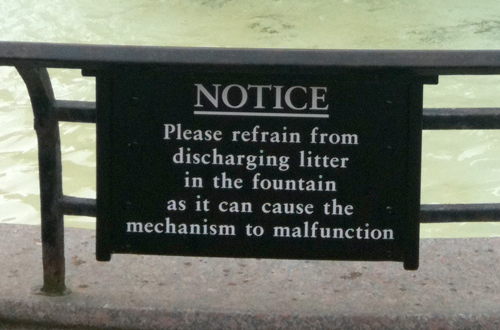
More photos from my visit to the UK:

Sign: please refrain from discharging litter in the fountain...

The verb ‘discharge’ would surely only apply to liquids or gases – effluent, not ‘litter’ – which doesn’t make much sense for a sign on a small, self-contained pool around an urban fountain. Where’s the Campaign for Plain English when you need them? (And, yes, I know I’ve mixed singulars and plurals there, but I don’t think it makes the sentence difficult to understand.)

That wasn’t the only sign on the fountain:
Continue reading “sign language”