sign language

More photos from my visit to the UK:
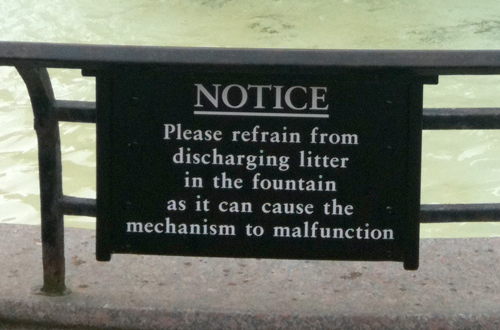
Sign: please refrain from discharging litter in the fountain...

The verb ‘discharge’ would surely only apply to liquids or gases – effluent, not ‘litter’ – which doesn’t make much sense for a sign on a small, self-contained pool around an urban fountain. Where’s the Campaign for Plain English when you need them? (And, yes, I know I’ve mixed singulars and plurals there, but I don’t think it makes the sentence difficult to understand.)

That wasn’t the only sign on the fountain:
Continue reading “sign language”

like a lamb

Staying in the UK with no internet connection for a week was a strange experience for someone who spends as many hours on-line as I usually do. Sadly, it didn’t result in vast quantities of poems being written long-hand in notebooks or anything very creative like that.

It did, however leave me a few photos that I intended for the blog and haven’t yet posted. Like this ‘co-operative lamb shank in gravy’.

Packaging label: The co-operative lamb shank in minted gravy
Continue reading “like a lamb”

gentle reader

My partner just brought me home a reader – what more could any writer want?!

Well, no, it’s an e-reader, and it’s only on loan, but it’s still enormously interesting. I quote from the manual, with my own reactions and thoughts in italics:

Note on use:
     Gentle reader,

• Replacement or repair of a broken or scratched touch panel is not covered by the warranty.
     So you can touch, but you mustn’t scratch, prod, niggle or pick. Mind you, even touching is fairly libertine for this day and age.
Continue reading “gentle reader”

see saw

Another BBC website headline that interests me:

Saw 'most successful horror film'


There’s nothing actually wrong with it, of course. It heads a story that starts:

Serial killer franchise Saw has been named the most successful horror movie series by the Guinness World Records.

But the phrasing demonstrates the problems of trying to write headlines that fit into a measured space on a web page (or printed page, for that matter.)
Continue reading “see saw”

Sound reasoning

A couple of weeks ago, on the Tantamount Words blog, I wrote about the USA Spelling Bee and commented about how a knowledge of the etymology of a word can help with spelling, particularly in a language like English where many different languages have contributed to the vocabulary.

Often, knowing how a word is pronounced is little help when it comes to writing it, but I personally don’t favour spelling reform as the written form can give us all sorts of clues about word families and relationships.
Continue reading “Sound reasoning”