automatic writing

Yesterday, I signed off an email to a colleague with the Spanish phrase que te sea leve. It seemed appropriate, knowing that the summer is upon us, compañeros de trabajo are off on holiday and teams that are stretched at the best of times are now at snapping point.

bare bone on bare earth
Let the earth lie light...
“Que te sea leve” ~ “may it (life) be light for you.”

I like the phrase, but had no idea of its derivation.

Fortunately, despite the absence of colleagues, there is usually time for an exchange of ideas and information, and he pointed out that this is more or less what the Romans put on the tombstones of loved ones:

Sic tibi terra levis. ~ Let the earth lie light upon you.

What a lovely phrase.

Still, that’s all rather incidental to this post, which was prompted by the actual physical act of typing que te sea leve, rather than by its meaning.
Continue reading “automatic writing”
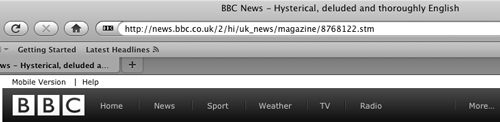
the BBC – the voice of reason?

Apparently not, if the title of this web page is anything to go by:

BBC news - Hysterical, deluded and thoroughly English

Yes, it is a page from the BBC website and it is entitled:

BBC News – Hysterical, deluded and thoroughly English.

Continue reading “the BBC – the voice of reason?”

verses and versions

One of the joys of speaking two languages is that you get far more opportunities for puns than monolinguists do.

It was with delight, then – and with a language hiccough mid-way – that I saw the following on the El País website earlier today:

Headline: El general McChrystal llega a la Casa Blanca para verse con Obama
Well-versed in military matters?

The word verse flipped my mind into English and conjured the wonderful image of Obama and McChrystal having a flyting contest.

Sound reasoning

A couple of weeks ago, on the Tantamount Words blog, I wrote about the USA Spelling Bee and commented about how a knowledge of the etymology of a word can help with spelling, particularly in a language like English where many different languages have contributed to the vocabulary.

Often, knowing how a word is pronounced is little help when it comes to writing it, but I personally don’t favour spelling reform as the written form can give us all sorts of clues about word families and relationships.
Continue reading “Sound reasoning”

him-her; big-small

“Las formas femeninas suelen ser más grandes.”

Well, that may not be the exact phrase my colleague used, but it was along those lines, and it wasn’t meant to insult women in anyway. We were discussing a translation for the Mexican word cenote and he was trying to explain what it meant. Not a pozo (a well), but a poza. But what was a poza? According to the RAE, it’s a:

Charca o concavidad en que hay agua detenida.

Note that the definition uses the word charca, not charco. Again, two similar forms; so what’s the difference?
Continue reading “him-her; big-small”