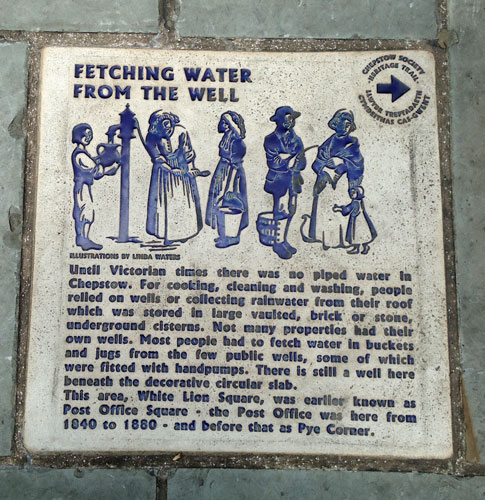
written in stone

decorative tile

A while back I commented on an engraving at Nottingham castle as it didn’t make sense to me to create a work of art using a nonsensical text.

I compared it to the phrases embedded in the streets of Chepstow, which I’ve always rather liked; these seem to make grammatical sense, and are mostly associated with the commerce and history of the town.
Continue reading “written in stone”

of telephones and translation

red telephone box

I went to a workshop in the Cotswolds last week, where we discussed translation and poetry. Specifically, translating the poems of Lorca, as it was related to the Lorca in England competition. I do want to write more about translation, but have been caught up in discussion of my other hobby horse, the narrator in poetry.

So, while I try and find time to compose my thoughts and write some more on the subject of translations, which, “like women, when faithful are seldom beautiful and when beautiful are unlikely to be faithful” – (I’m not sure who to attribute that thought to) – here’s a picture of an English telephone box, just to brighten the page.

talking about translation

The question arose recently about whether a translator should translate into their own mother tongue (direct translation) or into their second language (inverse translation). Someone expressed the adamant opinion that you should never trust a person who offered to translate into a language other than their own – they’d be bound to do it badly.

I actually disagree quite strongly.
Continue reading “talking about translation”

playing gooseberry

(Click here for a picture of male and female kiwi flowers)

As I’ve mentioned before, when I first saw kiwi fruit back in the Seventies, they were called Chinese gooseberries. But, although the fruit are greenish and furry and have tiny seeds, they aren’t really anything like gooseberries.

Or so I thought until we started growing them.

kiwi fruit in the early stages of development
Continue reading “playing gooseberry”

treachery, forgery, or the sincerest form of flattery?

I’ve been over at Cantueso’s blog again, looking at translations of a poem by Hans Magnus Enzensberger and wondering about some of the phrases. In the blog comments, Cantueso says:

[the English] translation is much better and much more faithful than [my Spanish]

Not knowing any German, it’s hard for me to comment on that, but the coupling of the two adjectives ‘better’ and ‘faithful’ catches my attention. It makes me think of the Italian expression traduttore, traditore – ‘translator, traitor’.
Continue reading “treachery, forgery, or the sincerest form of flattery?”