using language

I hadn’t realised that the library in Navarredonda was following a long and honourable Spanish tradition with their sign listing their rules and regulations for behaviour.
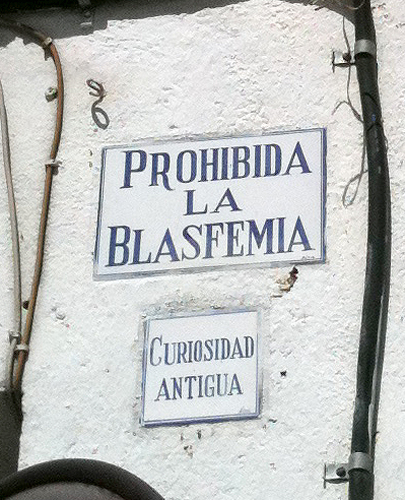
No blaspheming
Still, the tile in the photograph was spotted embedded in the wall outside a bar in Pedro Bernardo and does seem to be a genuine antique.

Presumably, though, the residents don’t want visitors to think that they are quite so stuck in the past as a ban on blasphemy and the image of a pony parked in the bull ring might lead you to believe. At least, I assume that’s why they felt the need to add the small explanatory tile that reads, “curiosidad antigua”.
Continue reading “using language”

all the rage

I haven’t been following the X-factor/Rage Against the Machine story, but it’s one of those things that filter through even if you aren’t the least bit interested in it, and the headlines this morning make it unmissable.

Even so, the only real interest I have in the story is that it’s triggered a memory of being asked by a Swedish friend’s son, back in the early Nineties, what Rage Against the Machine meant.
Continue reading “all the rage”

picture a fact

Don't confuse the narrator wordle
'Wordle' word cloud of last five blog posts

There was an interesting article on the BBC yesterday, about “information visualisation”, written by Davd McCandless, the guy behind the Information is Beautiful website.

The article discusses how information can often be shown more easily by pictures than by text, and includes a number of different types of graphic to demonstrate the point.
Continue reading “picture a fact”

a number of questions

Or, perhaps, a question of numbers.

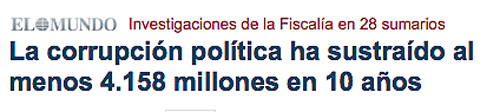
A headline in today’s El Mundo says that 4,158 million euros has been lost in the last ten years due to political corruption. Except, it being Spanish, it doesn’t say it quite like that:

Headline: la corrupción política ha sustraído al menos 4.158 millones en 10 años

The Spanish use “million” in the plural after a number, giving phrases like seis millones rather than “six million”. They also use a full stop as the thousands separator and a comma where we use a decimal point.
Continue reading “a number of questions”

parenthetical pedantry

The more I read on-line, the more I think the mathematicians have it right. The meaning of 4+3*6 is perfectly well defined. You have to do the multiplication first.

If you want to force the addition to be be done first, you just slip in some parentheses: (4+3)*6.

Sadly, text isn’t like that. And with the internet encouraging writing by all and sundry, and forcing hurried writing by those who should know better, it’s easy to produce potentially ambiguous statements like this, from a piece about the need to encourage social inclusion by reading, on the London Book Fair site:

Not only are those who read less likely to be divorced, but they are less likely to smoke and be unemployed

My original reading of the first phrase parsed “those who read less” as a unit, and the phrase apparently claimed members of this group were “likely to be divorced”.
Continue reading “parenthetical pedantry”