The local cinema is showing Polanski’s The Ghost Writer and this is the poster advertising the film: 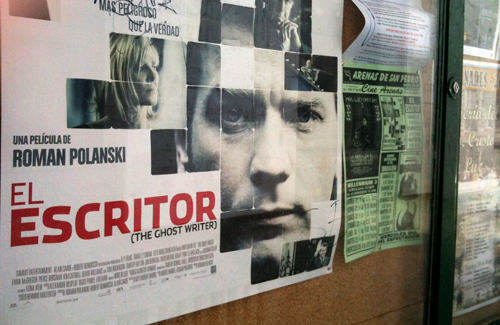
You’ll notice that the title has been translated into Spanish as El Escritor – The Writer. I wonder whether that’s because the word used for a “ghost writer” is negro.
Continue reading “pc or not pc”
Category: language & communication
political ambiguity
It’s the first time in decades that I’ve been in the UK for a general election, and I’m finding all this uncertainty absolutely fascinating. Maybe the fact I don’t have to live with the aftermath – at least not as a resident – helps.
I liked this quote from the BBC lunchtime television news today:
[The Liberal Democrats] must decide who they want to govern.
In normal speech, at least, that is delightfully ambiguous, and conjures the idea of the Lib Dems keeping their coalition partners, whichever party they might be, on a very short leash.
Technically, that interpretation probably demands the use of “whom”, but how many of Britain’s electorate would distinguish the grammatical forms?
sinful snacking

I’ve already commented on how fond the Spanish are of the genitivo sajón so I suppose the strange and entirely inappropriate little green leaf in the logo of this packet of “snatt’s” isn’t really surprising.
Still, it does make me wonder once again who does the copy writing and design for Spanish advertising agencies.
I imagine the brand name “snatt’s” is someone’s interpretation of the sound of the English word “snacks”. But what purpose does the leaf serve?
If it’s purely a design element, surely it could have been put somewhere where it wasn’t likely to be mistaken for an apostrophe? Or did the company chairman think that an apostrophe added a sophisticated English twist to the name?
Continue reading “sinful snacking”
use your loaf

Bread is important in Spain. Not what I’d call good, but important, all the same.
The two loaves in the picture look tempting, but they are both basically cotton-wool-style white bread. The one on the left, bought as un pan, will be easier to cut in a couple of days, and will make quite decent toast. At first sight, a foreigner may think the one on the right – una barra – will be like a French baguette. They’d be wrong. It’s pretty much the standard tasteless Spanish loaf, though the supermarket version tends to be rather cheaper and even more like cardboard than the ones I buy in the panadería.
Continue reading “use your loaf”
carry on shopping
Living in Spain, there are times when I feel as if I am looking at life through linguistic bi-focals: one lens is my mother tongue, English, the other is the local language, Spanish (Castellano).
 don't confuse the narrator